Monday, April 11, 2011

Sunday, April 10, 2011
| Free Hugs video http://www.youtube.com/watch?v=vr3x_RRJdd4  I Was A Cutter **WARNING- GRAPHIC IMAGES** http://www.youtube.com/watch?v=UjTtE3ECVmE&feature=related | |||||||
|---|---|---|---|---|---|---|---|
| Dedicated to the cutters in the world that would rather feel the physical pain than the emotional pain. (that's how I see it, others see it differently) When I was working at META Services there was 100% abuse in the people I visited. Many of us had weight problems as well but all were abused and most were cutters; men included. ...cal http://en.wikipedia.org/wiki/Self-harm Excerpt:
| |||||||

Excerpt:
Videos posted online that feature self-injury are popular viewing among young adults and possibly teens -- and some researchers worry that this may encourage copycat behaviors.
A study conducted using YouTube's search option entering the keywords "self-injury" and "self-harm," found that the 100 most frequently-viewed videos received more than 2.3 million views -- and often contained graphic depictions of cutting, burning, and self-embedding, according to Stephen Lewis, PhD, of the University of Guelph in Ontario, and colleagues.
Most of the videos did not have warnings about the content or viewing restrictions, Lewis and co-authors reported online ahead of the March issue of Pediatrics.
Pink (P!nk) - Fuckin' Perfect (Music Video) HQ [2011 *NEW*]
http://www.youtube.com/watch?v=s4Rax2PXiWA
Ashley Judd on 'The View' I was sexually abused
http://www.youtube.com/watch?v=q0s3XH3Okvk
Cher You Haven't Seen the Last of Me youtube
http://www.youtube.com/watch?v=vJgg695-Mck
Tina Turner and Cher on Oprah Proud Mary
http://www.youtube.com/watch?v=J9_AF80Ecow&feature=related
CCR Creedence Clearwater revival aka the Golliwogs (after the children's literary character, Golliwogg),
http://www.youtube.com/watch?v=kOfHOMpU4iE
Cyndi Lauper - True Color s
http://www.youtube.com/watch?v=wS53zuf_X10
Cyndi Lauper Girls Just Wanna Have Fun
http://www.youtube.com/watch?v=6UB9Yx_qa5s&feature=related
Cyndi Lauper Time after Time
http://www.youtube.com/watch?v=Q1VlRqeTkE0&feature=related

http://en.wikipedia.org/wiki/Self-harm
Excerpt:
Behaviours associated with substance abuse and eating disorders are usually not considered self-harm because the resulting tissue damage is ordinarily an unintentional side effect.[6] However, the boundaries are not always clear-cut and in some cases behaviours that usually fall outside the boundaries of self-harm may indeed represent self-harm if performed with explicit intent to cause tissue damage.[6] Although suicide is not the intention of self-harm, the relationship between self-harm and suicide is complex, as self-harming behaviour may be potentially life-threatening.[7] There is also an increased risk of suicide in individuals who self-harm[4][8] to the extent that self-harm is found in 40–60% of suicides.[9] However, generalising self-harmers to be suicidal is, in the majority of cases, inaccurate.[10][11]

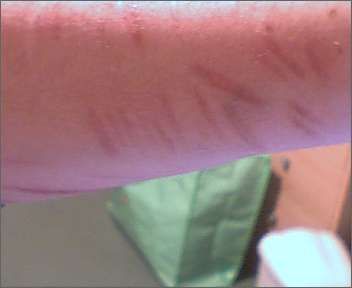

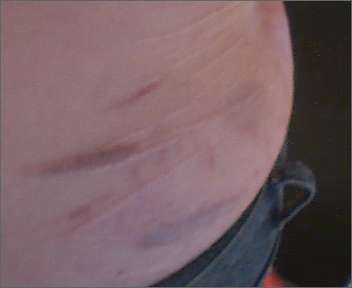










I have a very good friend who has been bulimic for over 40 years. She is addicted to sugar sweetners and has abused diet pills. She had kidney stones early on, cancer in the 90's and a stroke 2 years ago. She's very good at hiding this and goes to great lengths to cover her tracks. She is very beautiful but has had many plastic surgeries. I only wish I could help her but the last time we talked she is convinced she is going to die soon.
Excerpt:
Every person is unique, and any description will be a gross generalization. There are other factors that can sometimes be found in the history of a bulimic sufferer - sometimes there may have been incidences of sexual abuse during childhood, and often, the child was overweight and experienced some of the jeers and teasing that went along with this. The child may have also been "dieting" from a young age.
Due to the shame involved, the bulimic can often be extremely secretive, making it difficult to truly know what is going on. Some of the more obvious symptoms include:
| Crimson | ||
|---|---|---|
 | ||
| Hex triplet | #DC143C | |
| RGBB | (r, g, b) | (220, 20, 60) |
| HSV | (h, s, v) | (348°, 91%, 86[1]%) |
| Source | X11 | |
| B: Normalized to [0–255] (byte) | ||
Crimson is a strong, bright, deep red color. It is originally the color of the dye produced from a scale insect, Kermes vermilio, but the name is now also used as a generic term for those slightly bluish-red colors that are between red and rose; besides crimson itself, these colors include carmine, raspberry, ruddy, ruby, amaranth, and cerise.
Crimson also has a Biblical meaning symbolizing the presence of God and the blood of martyrs. It is the Christian liturgical color for Pentecost and represents atonement and humility
Crimson, the Color of Peace
by Cal 
When we hurt and we cry and the clear liquid tears cannot take away the pain.
The color of Crimson is inviting and it shows the life. When tears NO longer are enough, the color Crimson sometimes leaves a stain that shows the pain.
Crimson, the color of blood
The slow drip, the next slash, the stream, and then the
smell.
Crimson, until it turns dark brown then black on the towel, on the chair, on the rug.
The puddle, and then the stain, grows as it seeps deeply into the material.
It's fascinating watching the life drip drip drip at first then spurt
then it flows steadily.
I care no more to stop it, it continues to drain the life force from
me and I feel faint.
I remember long ago when a bottle of crimson color wine made my head feel light and once or twice, or maybe a hundred times, it made the pain feel less,
at least for a moment or an hour or a day.
Once or twice or was it a thousand times it made the pain worse
and the razor............ more alluring.
I only want the nothingness now. The pain of it all is too much and
the color of crimson seems to fill my every sense. I feel the heart
pulsating crimson.
I feel the weakness, I smell the odor.
Crimson has it's own smell you know.
And I taste the crimson taste in my mouth as I lick my finger. I see the dark dark color of it all around.
 I feel the life flowing out of me in a dark red hue. It has it's own feeling as my head lightens, and my thoughts dissolve. (I wonder if the last drop of life is a lighter shade of color, or is it still dark crimson?)
 I visualize a river of crimson.
I'm awake again now and the wounds cannot be seen.
The bandages cover them.
The white sheets feel soft to the touch and the sterile atmosphere of room makes me wonder where I am.

Underneath the bandages the wounds are no longer laid open. (Now the crimson has turned a boring pink as the gashes are sewn and the surrounding area is only a line with little dots of dark.)
Where am I? How did I get here?
She says I called to say good-bye (Her name is Terri Peace maiden name Terri Cross and she's Pebbles in my story. One of our facilitators at Meta Services was Wilma and she died while Terri and I worked at Meta. She shared with me that I had held the Hope for her when hers was gone. She loved my story and inspired me to write it night after night as she had something wonderful to look forward to. I have 3 children and none of the 3 ever wanted to even read the first few paragraphs.)
as the pain was too much but I don't remember. She says she was on
the phone with me when I passed out.
 This photo looks very much like the Pebbles doll I gave Terri when we became friends. She slept with her (even tho she had 3 children of her own. I think I was a stand in mom for her till her mom moved to AZ to live with her. ) ...cal
This photo looks very much like the Pebbles doll I gave Terri when we became friends. She slept with her (even tho she had 3 children of her own. I think I was a stand in mom for her till her mom moved to AZ to live with her. ) ...cal"Why? I asked, "did you call to save me? You knew of my pain, you knew of my ache."
"You called to say good-bye and I wasn't ready for you to leave me. I didn't want to go forward without you. I was selfish. I wanted you here with me to continue teaching and helping me to help myself."
"You loved me when others didn't. You believed in me when others didn't. You held the hope for me when I couldn't hold it for myself.
I want to do that for you now."
"But I don't want it back. I don't want the hope again only to have it stricken from me over and over. I cannot believe again as it hurts too much.
If it happens again, let me go. If I call, please say good-bye and simply hang up.
If it's selfish, I'm sorry, but the pain is too much. I cannot do enough to make the pain go away. I cannot heal enough not to feel the pain.
I want to go home where it's quiet
and tranquil and there is nothing. I want to leave this place for
it isn't a place for gentle spirits.
It has no hug coupons and I need those.
I cannot continue to fight, it's too much.
Please, let me go and plant a crimson rose
for me as my rainbow spirit flies away where a breeze blows and stars shine golden. Love me enough to let me go."


colorless no name..........
Her name is Amber and I met her while working in the mental health field.
She was 22 when we met and she is the most incredibly beautiful young woman you can imagine. She has the natural beauty that isn't found every day and she is totally unaware of it.
We became really close and I must admit I loved mothering her. She loved it as well and we had fun once a week for 2 months.
I have to share this although I'm not sure why.....
hee hee.......... maybe just a woman thingy, eh?
When I arrived to Amber's apartment that first day, her hair was beautifully blonde and I was sure it was her natural color. The next week, when I got there, her hair was black...... and whatever the reason for sharing this, THIS YOUNG WOMAN looked natural in both extremely different colors???????? (Now, go figure, I thought because of a person's skin tone that this was impossilbe........ but found that not to be so.)
..........back on topic
Amber had joined the Army reserves a year and a half before our meeting as the economy was very bad and she had trouble finding a job and keeping an apartment.
Amber had a daughter when she was very young and in order to join the reserves, Amber had to sign away her rights as a mother. (I didn't know whether or not to believe that but after researching it after our last visit, I found it is very prevalent in today's world that young people do this.) Don't get me wrong, I didn't think Amber would lie to me but I just thought it outrageous that it was a requirement.
Amber shared that she was fine with the adoption of her daughter as the couple lived in Scottsdale AZ and could give her a wonderful life.
I noticed on my first visit that Amber had tattoos and I inquired about them. She teared up and shared that she felt compelled to tattoo her young daughter's name every chance she got. She had many tats with her daughter's name and one or two others, if I remember correctly, one was a rose.
On my second visit Amber had on a pair of shorts. There again was a tattoo of her daughter on her leg........... Amber shared that her money had run out for tattoos and she felt compelled to carve her daughter's name into her leg. (The really frightening part was that the baby's name was totally legible and very large.)
I had an extra journal in my car and I gave it to Amber. Little did I know that she would decorate it so beautifully by the next visit. It had wonderful photos of Amber and her daughter. (I was stunned as the journal looked truly as if a professional had done it.) The photos of her daughter and Amber made me totally sad as her child looked like a clone of Amber.
I bought her some pens, glitter and glue and gave her another journal before we finished our sessions. She made some incredible books and she was a genius at crafts.
Amber had been sent to me as a peer as she had been hospitilized in a coma from ODing. She had done terrible damage to her organs and was not expected to live. Upon coming out of the coma, she overheard her mother ask her doctor why he had revived Amber.
I wrote this poem before meeting with Amber but felt it appropriate to dedicate it to her now.
Oh, and BTW, before ODing, Amber had been discharged from the reserves after boot camp with a medical discharge........ she shared with me some of her experiences at boot camp and if I can bear to write about them at a later date, I'll try and share some of those with you all.
When I hear all the horrible stories now that women in the reserves have had to endure I know they are true. 
Excerpt:
Dissociation is a partial or complete disruption of the normal integration of a person’s conscious or psychological functioning.[1] Dissociation can be a response to trauma or drugs and perhaps allows the mind to distance itself from experiences that are too much for the psyche to process at that time.[2] Dissociative disruptions can affect any aspect of a person’s functioning.[3][4][5][6] Although some dissociative disruptions involve amnesia, the vast majority of dissociative events do not.[7] Since dissociations are normally unanticipated, they are typically experienced as startling, autonomous intrusions into the person's usual ways of responding or functioning. Due to their unexpected and largely inexplicable nature, they tend to be quite unsettling.
Different dissociative disorders have different relationships to stress and trauma.[8] Dissociative amnesia and fugue states are often triggered by life stresses that fall far short of trauma.[9][10] Depersonalization disorder is sometimes triggered by trauma, but may be preceded only by stress, psychoactive substances, or no identifiable stress at all.[11]
From my story..........
Olivia hears the soft muffled crying. She gazes down and there is a heap of something right over by the bushes. She sees it move.
Lee is laying in a fetal position and doesn’t hear when Olivia asks, ”Who’s there?”
Olivia edges nearer to Lee, she doesn’t know it’s a person yet but as she gets closer she is starting to recognize the form of a woman. She leans down and tries to uncover the woman. Now, there is constant movement. The person is shivering as if she is freezing.
Olivia softly asks, ”May I help you?”
The body can’t seem to comprehend.
”I have a doctor in the house in the back, should I go get him?”
”NoOooooOoooo, please, I’m OoOoKkkkK.”
”Here then, let me help you up.”
”NO, please just a minute and I’ll get up and leave.”
”You don’t have to leave, just please, let me help you,” Olivia moves closer.
”NOOOOOOOOOOOOOOOO,” the figure screams when she’s touched.
”Young woman, please do not scream at me. I will not hurt you.”
”Ahhhhh, mmmm, I i I’m sorry, please, just give me a minute. I had a hard time that’s all and I’ll be better in just a minute.”
”Ok then.” Lee stumbles to her feet.
”I’m sorry, may I take a moment, I don’t know how I got here.”
”Well, from the looks of that line in the dirt over there, it looks like you walked here in that blanket.”
”I don’t remember.”
”May I help you into my home?”
”Miss, do I know you?”
”No, I don’t think so.”
”Cal, is that you?”
”Excuse me, my name is Lee.”
”Cal, quit fooling with me, this is Olivia. I’ve seen your picture.”
The woman falls again into a heap. She has passed out or something. Olivia cannot quite figure it out.
”I’m getting Robbie here now”, Olivia whispers to herself.
Olivia calls Rob on the cell phone.
”Robbie, please come to the main house now.”
”I’ll be right there.”
”Yes mi lady?”
”Do you recognize this person?”
”Oh my God, Olivia, it’s Cal.”
”Just what I thought.”
”Robbie, take her into the guest house please.”
Cal’s eyes open and she sees Rob.
”Hey RobbieMi`Robot, what??????”
”Shhhhhhhhhhhh Cal, you’ll be fine.”
”What is going on?”
”Nobody knows at this time, Cal.”
”Cal, who is Lee?” asks Olivia.
”Lee is my middle name but why do you ask?”
”Never mind, my dear, just rest for a bit.”
”Oh my God, oh my God..... I can’t believe it, now I remember.”
”Cal, what do you remember?”
”What did you call me, my name is Lee.”
”Cal, quit that,” Robbie insists.
”Quit what, my name is Lee.”
”What did you remember, Cal?”
”I told you my name - IS NOT CAL, it’s Lee.”
”Ok, what did you remember?”
”What are you talking about?”
”STOP THAT right now!”
”Listen, who ever or what ever you are, You stop it.”
”Do you mind if I rest a bit?”
”Sure, go right ahead.”
Cal lays back on the pillow and soon is sleeping soundly.
”Rob, what do you suppose is going on?” Olivia asks softly.
”I think we should tell the doctor what just happened when he’s finished with
Tomar and have him talk to Cal.”
Tomar and have him talk to Cal.”
”Sounds like a fine idea to me.”
”I’ll go check and see how things are going with him and our lil patient.”
”Ok my son. I’ll stay close here and keep an eye on our visitor.”
...I am changing to first person now as it is how I need to be to get through this part. If I change mid stream it is because I need to in order to relay the information I have to share.
My eyes open and Miss Olivia is standing above me.
”May I ask with whom I am speaking?”
”Hi Ms. Olivia, I’m Cal.”
”Good, do you know where you are.”
”Yes, my short nap gave my brain some time out and now I am ready to share with you.”
”You met Lee, didn’t you?” Cal asks?
”Excuse me young lady, what do you mean, I met you.”
”No, I’m sorry, you met Lee, now let me explain.”
”Humph..... well then explain.”
”It’s a long story Ms. Olivia but I will try and shorten it for you.”
”I had a flash back last night and I relapsed.”
”Let me make this as short as I can so you’ll understand.”
”When I was a child, I was abused and in order to get through it, I became another person. It happens frequently in the mental health community and I have what they call a borderline personality.”
”They are still testing me to see if indeed it is borderline or multiples. I tell them it isn’t multiples as usually I am aware, just not totally me anymore. Well, I guess you know I’m not me at all but the doctors don’t need to know that. As long as I can handle it when I wake up.”
”I see, you’re pulling my leg, right?”
”No no I’m not. I won’t say I wish I were because if that were the case, I probably would not have survived. I become Lee when Cal is in danger.”
”Were you in danger when you ended up here?”
”Are you sure you want to hear this?”
”Yes, my dear, I am very interested.”
”OK, then here goes.”
”When I was a child, I liked to run around naked and I would pose in front of the mirror and I would play like that until my mother caught me. Then she would belittle me and she would spank me and she would tell me I was naughty and ugly. She would say I was bad and I should not look at myself and I should always cover my body.”
”Miss Olivia, I didn’t think I was any of those things. I thought I was pretty and I liked to see my own body and I guess I got very confused. Do you think I am ugly Miss Olivia?”
”My my my Cal, I don’t have an opinion one way or the other.”
”Well, it got worse. After a while, I couldn’t tell if I was pretty, which I thought, or ugly which she thought. I guess that’s when Lee came out. She would tell me I was pretty and she would take my clothes off and she would kiss the mirror and she played like I used to play.”
”One day I woke up on the floor and my clothes were on me all buttoned wrong and I had a big gash in my lip and I had bruises and I hurt.”
”I got up and my mother started yelling at me. I went in the bathroom and threw up and I changed my clothes.”
”I threw up all the time then. I couldn’t eat. I guess Lee would eat because sometimes I would find myself in the bathroom throwing up.”
”My mother and father took me to a special doctor and the doctor made an appointment at the lab to have some tests. I had to return another day and not eat or drink any liquids.”
”I had to drink this awful stuff at the hospital and they took x-rays or something and ran a whole bunch of tests.”
”The doctor told my mother I was allergic to different foods. I think I was allergic to myself.”
”I still threw up. I remember one day, we had watched a movie in school and we had ice cream and as I was walking out the door, I threw up all over myself, I was so embarassed.”
”One other time, I was in the kitchen and when I turned around my mother had a knife in her hand and she was shaking it at me and told me if she caught me one more time naked, she was going to show me. The next thing I knew the knife was flying at me.”
”I guess Lee had been posing again as my hair was in a ponytail and I never wore it that way.”
”Olivia, I think I’m pretty but I don’t know. Sometimes when people compliment me, I get scared. I think maybe they see something that I don’t. I have pictures of myself and I don’t think they are me.”
”So, now, here’s what’s going on, ok? I have someone who wants to meet me and see what I look like. Olivia, I don’t know what I look like. I don’t know if he’ll like me or not because I just don’t know.”
”He is so special to me that I am afraid. I threw up two days ago and now it’s back. Not just that, but Lee keeps coming out too and I’m scared.”
”My dear, please don’t worry. You’re very lovely.”
”You say that and often times I know that but sometimes when I look in the mirror I see my mother. She is glaring at me and she is telling me I am ugly and I should not be looking at myself.”
”To tell you the truth I don’t talk to my doctors about this. I don’t want another medication if I am diagnosed with multiples. I don’t care as long as I’m alone what I look like. I think I’m fine but I really like this man and I don’t want him to think I’m ugly. In my heart, I know I’m not but I don’t even want to address it anymore. I’m tired after all of these years.”
”Hi doc.”
”May I help you Miss Olivia, Robbie said you wanted me to talk to someone.”
”I think we’re fine now, aren’t we Cal?”
”Yes, thank you. I think I’m ok now.”
”Well, I’ll get back to Tomar if you don’t need me. It was nice meeting you, is it Cal?”
”Yes, Cal will do just fine.”
”Olivia, would you mind if I ask for a glass of water? I have to take my medication. Oh, never mind, I must have left them at home.”
”Cal, how did you get here?”
”I’m not sure, Miss Olivia. I think Lee must have been out.”
”I think we’re too far out for you to have walked, let me send Rob out to see if he can find out how you got here. Maybe you drove.”
”Thanks, if I did, and my purse is in the car, my meds will be in it. That will be goodness as I think I need them now.”
”Rob, would you come to the guest house please?”
”Never mind, would you drive around the castle and see if you can find Cal’s car?”
”Do you have any keys on you, Cal?”
”Hmmmmmm, yes, here they are in my pocket. Wow, I am impressed, in the middle of this, I actually brought my keys. I amaze myself sometimes.”
”We found them. Will you take Haley with you to drive it back? Ok, we’ll be here. I think she’s going to take a nap and then maybe if we treat her very nicely, she’ll stay for dinner. She can eat with Tomar and the nurse. I’ll have something made up for them as soon as you get back.”


Port Wines
Port comes from the city of Oporto, in the Duoro Valley of Portugal. Port is always red wine and it's sold in several different styles. Vintage Port - from a single year and best aged for at least a decade, Tawny Port - a blend of ports from several years and aged for as many as 30 years in the cask, and Ruby Port - a crimson colored blend of lesser, younger ports.
No wonder I find myself in mental distress, look at what I found in an ad for Crimson Flight Garnet Necklace. OMG!!! ...cal
WARNING: Attention California residents: This product contains lead, a chemical known to the State of California to cause cancer and birth defects or other reproductive harm.
Crimson Rose Atrophaneura hector is a large swallowtail butterfly belonging to the subgenus Pachliopta (Roses) of the Red-bodied Swallowtails (genus Atrophaneura).
| Crimson Rose | |
|---|---|
 | |
 |  |  |  |  |
 |  |


What is it about hugs that make them so stress-relieving, even when they come from complete strangers? When we’re feeling low, getting a gentle squeeze provides comfort like nothing else. There are even therapeutic practices centered on hugging. When it comes to our health, turns out the best thing we can do is open our arms.
| Free Hugs video http://www.youtube.com/watch?v=vr3x_RRJdd4 |
|---|
All The Same lyricsI dont mind where you come from
As long as you come to me
But I dont like illusions I cant see
Them clearly
I dont care, no I wouldn't dare
To fix the twist in you
You've shown me eventually what you'll do
I dont mind
I dont care
As long as you're here
[Chorus]
Go ahead and tell me you'll leave again
You'll just come back running
Holding your scarred heart in hand
It's all the same
And I'll take you for who you are
If you take me for everything
And do it all over again
It's all the same
Hours slide and days go by
Till you decide to come
But in-between it always seems too long
Suddenly
But I have the skill, yeah
I have the will, to breath you in while I can
However long you stay is all that I am
[| From: http://www.elyrics.net/read/s/sick-puppies-lyrics/all-the-same-lyrics.html |]
I dont mind, I dont care
As long as you're here
Go ahead and tell me you'll leave again
You'll just come back running
Holding your scarred heart in hand
It's all the same
And I'll take you for who you are
If you take me for everything
And do it all over again
It's always the same
Wrong or Right
Black or White
If I close my eyes
Its all the same
In my life
The compromise
I'll close my eyes
Its all the same
Go ahead say it
You're leaving
You'll just come back running
Holding your scarred heart in hand
It's all the same
And I'll take you for who you are now
If you take me for everything
Do it all over again
It's all the same
As long as you come to me
But I dont like illusions I cant see
Them clearly
I dont care, no I wouldn't dare
To fix the twist in you
You've shown me eventually what you'll do
I dont mind
I dont care
As long as you're here
[Chorus]
Go ahead and tell me you'll leave again
You'll just come back running
Holding your scarred heart in hand
It's all the same
And I'll take you for who you are
If you take me for everything
And do it all over again
It's all the same
Hours slide and days go by
Till you decide to come
But in-between it always seems too long
Suddenly
But I have the skill, yeah
I have the will, to breath you in while I can
However long you stay is all that I am
[| From: http://www.elyrics.net/read/s/sick-puppies-lyrics/all-the-same-lyrics.html |]
I dont mind, I dont care
As long as you're here
Go ahead and tell me you'll leave again
You'll just come back running
Holding your scarred heart in hand
It's all the same
And I'll take you for who you are
If you take me for everything
And do it all over again
It's always the same
Wrong or Right
Black or White
If I close my eyes
Its all the same
In my life
The compromise
I'll close my eyes
Its all the same
Go ahead say it
You're leaving
You'll just come back running
Holding your scarred heart in hand
It's all the same
And I'll take you for who you are now
If you take me for everything
Do it all over again
It's all the same
Monday, March 28, 2011
http://www.tsrocks.com/s/stevie_wonder_texts/you_havent_done_nothing.html
You Haven't Done Nothing (Stevie Wonder)
We are amazed but not amused
By all the things you say that you'll do
Though much concerned but not involved
With decisions that are made by you
But we are sick and tired of hearing your song
Telling how you are gonna change right from wrong
'Cause if you really want to hear our views
"You haven't done nothing"!<a href="http://www.testimania.com/">Testi Canzoni</a>
It's not too cool to be ridiculed
But you brought this upon yourself
The world is tired of pacifiers
We want the truth and nothing else
And we are sick and tired of hearing your song
Telling how you are gonna change right from wrong
'Cause if you really want to hear our views
"You haven't done nothing"!
Jackson 5 join along with me say
Doo doo wop - hey hey hey
Doo doo wop - wow wow wow
Doo doo wop - co co co
Doo doo wop - naw naw naw
Doo doo wop - bum bum bum
Doo doo wop
We would not care to wake up to the nightmare
That's becoming real life
But when mislead who knows a person's mind
Can turn as cold as ice un hum
Why do you keep on making us hear your song
Telling us how you are changing right from wrong
'Cause if you really want to hear our views
"You haven't done nothing"!
Yeah
Jackson 5 sing along again say
Doo doo wop
Doo doo wop - oh
Doo doo wop - co co co
Doo doo wop - sing it baby
Doo doo wop - bum bum bum
Doo doo wop - um
Sing it loud for your people say
Doo doo wop - um um um
Doo doo wop - stand up be counted, say
Doo doo wop - co co co
Doo doo wop - ow
Doo doo wop - bum bum bum
Doo doo wop - ah hum
http://en.wikipedia.org/wiki/You_Haven't_Done_Nothin'
"You Haven't Done Nothin'" is a 1974 funk single by Stevie Wonder featuring background vocals from The Jackson 5 and featured on the album Fulfillingness' First Finale. The politically-aware song became Wonder's fourth number-one pop hit, his tenth number one soul hit.[1] and was one of his angriest political statements aimed squarely at former President Richard Nixon. This song also features a thick clavinet track and an early appearance of the drum machine. The B-side of this single was "Big Brother", also a political statement from his earlier album Talking Book.
"Big Brother" Stevie Wonder youtube
http://www.youtube.com/watch?v=l1lz-ybIByM
http://en.wikipedia.org/wiki/December,_1963_(Oh,_What_a_Night)
Excerpt:
"December 1963 (Oh, What A Night)" is a hit single by The Four Seasons, written by original Four Seasons keyboard player Bob Gaudio and his future wife Judy Parker, produced by Gaudio, and included on the group's 1975 album, Who Loves You.
This single was released in December 1975 and hit number one on the UK Singles Chart on February 21, 1976. It repeated the feat on the U.S. Billboard Hot 100 on March 13, 1976, remaining in the top spot for three weeks and one week on Cash Box. On April 10 of the same year, it topped the RPM National Top Singles Chart in Canada.[1] New drummer Gerry Polci and bassist Don Ciccone shared lead vocals with long-time frontman Frankie Valli.
The song was originally about the repeal of Prohibition with the title of "December 5th, 1933," [2] but the lyrics were changed at the urgings of Valli and lyricist Parker. The song became a nostalgic remembrance of a young man's "first time" with a woman. In the Broadway play Jersey Boys, the song accompanied the Bob Gaudio character being set up with a prostitute by the other Four Seasons, in order to lose his virginity.
In 1994, the record was re-released with added percussion effects and remixed vocals (mixed by Dutch disc jockey Ben Liebrand in 1988). This version of "December 1963" spent 27 weeks on the Hot 100 (matching the chart life of the original single). The peak position of the remix version was #14.
Adding together the two 27-week chart runs from 1976 and 1994 gives the song the longest tenure ever on the Billboard Hot 100 music chart.[3]
The song was used in promos for KFRE in Fresno, CA from 2002 to 2004.
Give Peace a Chance John Lennon and Yoko Ono (see Tommy Smothers in the video.........) did you all know that Steve Martin is to perform w/Sir Paul ...cal
http://www.youtube.com/watch?v=acb15JsCGSk
Steve Martin and Steep Canyon Rangers official site
http://www.steepcanyon.com/news.asp
Dixie Chicks and Steve Martin
http://www.theboot.com/2010/07/23/dixie-chicks-steve-martin/
Steve Martin feat. Dixie Chicks "You" youtube
http://www.youtube.com/watch?v=Eg2EwqOjtDU
http://afteramerica.wordpress.com/2010/02/14/the-cia-created-the-hippie-movement-in-the-1960s/
Excerpt:

Inside The LC: The Strange but Mostly True Story of Laurel Canyon and the Birth of the Hippie Generation
Part I
There’s something happening here
What it is ain’t exactly clear”
Join me now, if you have the time, as we take a stroll down memory lane to a time nearly four-and-a-half decades ago – a time when America last had uniformed ground troops fighting a sustained and bloody battle to impose, uhmm, ‘democracy’ on a sovereign nation.
It is the first week of August, 1964, and U.S. warships under the command of U.S. Navy Admiral George Stephen Morrison have allegedly come under attack while patrolling Vietnam’s Tonkin Gulf. This event, subsequently dubbed the ‘Tonkin Gulf Incident,’ will result in the immediate passing by the U.S. Congress of the obviously pre-drafted Tonkin Gulf Resolution, which will, in turn, quickly lead to America’s deep immersion into the bloody Vietnam quagmire. Before it is over, well over fifty thousand American bodies – along with literally millions of Southeast Asian bodies – will litter the battlefields of Vietnam, Laos and Cambodia.
For the record, the Tonkin Gulf Incident appears to differ somewhat from other alleged provocations that have driven this country to war. This was not, as we have seen so many times before, a ‘false flag’ operation (which is to say, an operation that involves Uncle Sam attacking himself and then pointing an accusatory finger at someone else). It was also not, as we have also seen on more than one occasion, an attack that was quite deliberately provoked. No, what the Tonkin Gulf incident actually was, as it turns out, is an ‘attack’ that never took place at all. The entire incident, as has been all but officially acknowledged, was spun from whole cloth. (It is quite possible, however, that the intent was to provoke a defensive response, which could then be cast as an unprovoked attack on U.S ships. The ships in question were on an intelligence mission and were operating in a decidedly provocative manner. It is quite possible that when Vietnamese forces failed to respond as anticipated, Uncle Sam decided to just pretend as though they had.)
Nevertheless, by early February 1965, the U.S. will – without a declaration of war and with no valid reason to wage one – begin indiscriminately bombing North Vietnam. By March of that same year, the infamous “Operation Rolling Thunder” will have commenced. Over the course of the next three-and-a-half years, millions of tons of bombs, missiles, rockets, incendiary devices and chemical warfare agents will be dumped on the people of Vietnam in what can only be described as one of the worst crimes against humanity ever perpetrated on this planet.
Also in March of 1965, the first uniformed U.S. soldier will officially set foot on Vietnamese soil (although Special Forces units masquerading as ‘advisers’ and ‘trainers’ had been there for at least four years, and likely much longer). By April 1965, fully 25,000 uniformed American kids, most still teenagers barely out of high school, will be slogging through the rice paddies of Vietnam. By the end of the year, U.S. troop strength will have surged to 200,000.
Meanwhile, elsewhere in the world in those early months of 1965, a new ‘scene’ is just beginning to take shape in the city of Los Angeles. In a geographically and socially isolated community known as Laurel Canyon – a heavily wooded, rustic, serene, yet vaguely ominous slice of LA nestled in the hills that separate the Los Angeles basin from the San Fernando Valley – musicians, singers and songwriters suddenly begin to gather as though summoned there by some unseen Pied Piper. Within months, the ‘hippie/flower child’ movement will be given birth there, along with the new style of music that will provide the soundtrack for the tumultuous second half of the 1960s.

An uncanny number of rock music superstars will emerge from Laurel Canyon beginning in the mid-1960s and carrying through the decade of the 1970s. The first to drop an album will be The Byrds, whose biggest star will prove to be David Crosby. The band’s debut effort, “Mr. Tambourine Man,” will be released on the Summer Solstice of 1965. It will quickly be followed by releases from the John Phillips-led Mamas and the Papas (“If You Can Believe Your Eyes and Ears,” January 1966), Love with Arthur Lee (“Love,” May 1966), Frank Zappa and The Mothers of Invention (“Freak Out,” June 1966), Buffalo Springfield, featuring Stephen Stills and Neil Young (“Buffalo Springfield,” October 1966), and The Doors (“The Doors,” January 1967).

One of the earliest on the Laurel Canyon/Sunset Strip scene is Jim Morrison, the enigmatic lead singer of The Doors. Jim will quickly become one of the most iconic, controversial, critically acclaimed, and influential figures to take up residence in Laurel Canyon. Curiously enough though, the self-proclaimed “Lizard King” has another claim to fame as well, albeit one that none of his numerous chroniclers will feel is of much relevance to his career and possible untimely death: he is the son, as it turns out, of the aforementioned Admiral George Stephen Morrison.
And so it is that, even while the father is actively conspiring to fabricate an incident that will be used to massively accelerate an illegal war, the son is positioning himself to become an icon of the ‘hippie’/anti-war crowd. Nothing unusual about that, I suppose. It is, you know, a small world and all that. And it is not as if Jim Morrison’s story is in any way unique.

During the early years of its heyday, Laurel Canyon’s father figure is the rather eccentric personality known as Frank Zappa. Though he and his various Mothers of Invention line-ups will never attain the commercial success of the band headed by the admiral’s son, Frank will be a hugely influential figure among his contemporaries. Ensconced in an abode dubbed the ‘Log Cabin’ – which sat right in the heart of Laurel Canyon, at the crossroads of Laurel Canyon Boulevard and Lookout Mountain Avenue – Zappa will play host to virtually every musician who passes through the canyon in the mid- to late-1960s. He will also discover and sign numerous acts to his various Laurel Canyon-based record labels. Many of these acts will be rather bizarre and somewhat obscure characters (think Captain Beefheart and Larry “Wild Man” Fischer), but some of them, such as psychedelic rocker cum shock-rocker Alice Cooper, will go on to superstardom.
Zappa, along with certain members of his sizable entourage (the ‘Log Cabin’ was run as an early commune, with numerous hangers-on occupying various rooms in the main house and the guest house, as well as in the peculiar caves and tunnels lacing the grounds of the home; far from the quaint homestead the name seems to imply, by the way, the ‘Log Cabin’ was a cavernous five-level home that featured a 2,000+ square-foot living room with three massive chandeliers and an enormous floor-to-ceiling stone fireplace), will also be instrumental in introducing the look and attitude that will define the ‘hippie’ counterculture (although the Zappa crew preferred the label ‘Freak’). Nevertheless, Zappa (born, curiously enough, on the Winter Solstice of 1940) never really made a secret of the fact that he had nothing but contempt for the ‘hippie’ culture that he helped create and that he surrounded himself with.
Given that Zappa was, by numerous accounts, a rigidly authoritarian control-freak and a supporter of U.S. military actions in Southeast Asia, it is perhaps not surprising that he would not feel a kinship with the youth movement that he helped nurture. And it is probably safe to say that Frank’s dad also had little regard for the youth culture of the 1960s, given that Francis Zappa was, in case you were wondering, a chemical warfare specialist assigned to – where else? – the Edgewood Arsenal. Edgewood is, of course, the longtime home of America’s chemical warfare program, as well as a facility frequently cited as being deeply enmeshed in MK-ULTRA operations. Curiously enough, Frank Zappa literally grew up at the Edgewood Arsenal, having lived the first seven years of his life in military housing on the grounds of the facility. The family later moved to Lancaster, California, near Edwards Air Force Base, where Francis Zappa continued to busy himself with doing classified work for the military/intelligence complex. His son, meanwhile, prepped himself to become an icon of the peace & love crowd. Again, nothing unusual about that, I suppose.

Zappa’s manager, by the way, is a shadowy character by the name of Herb Cohen, who had come out to L.A. from the Bronx with his brother Mutt just before the music and club scene began heating up. Cohen, a former U.S. Marine, had spent a few years traveling the world before his arrival on the Laurel Canyon scene. Those travels, curiously, had taken him to the Congo in 1961, at the very time that leftist Prime Minister Patrice Lumumba was being tortured and killed by our very own CIA. Not to worry though; according to one of Zappa’s biographers, Cohen wasn’t in the Congo on some kind of nefarious intelligence mission. No, he was there, believe it or not, to supply arms to Lumumba “in defiance of the CIA.” Because, you know, that is the kind of thing that globetrotting ex-Marines did in those days (as we’ll see soon enough when we take a look at another Laurel Canyon luminary).
Making up the other half of Laurel Canyon’s First Family is Frank’s wife, Gail Zappa, known formerly as Adelaide Sloatman. Gail hails from a long line of career Naval officers, including her father, who spent his life working on classified nuclear weapons research for the U.S. Navy. Gail herself had once worked as a secretary for the Office of Naval Research and Development (she also once told an interviewer that she had “heard voices all [her] life”). Many years before their nearly simultaneous arrival in Laurel Canyon, Gail had attended a Naval kindergarten with “Mr. Mojo Risin’” himself, Jim Morrison (it is claimed that, as children, Gail once hit Jim over the head with a hammer). The very same Jim Morrison had later attended the same Alexandria, Virginia high school as two other future Laurel Canyon luminaries – John Phillips and Cass Elliott.

“Papa” John Phillips, more so than probably any of the other illustrious residents of Laurel Canyon, will play a major role in spreading the emerging youth ‘counterculture’ across America. His contribution will be twofold: first, he will co-organize (along with Manson associate Terry Melcher) the famed Monterrey Pop Festival, which, through unprecedented media exposure, will give mainstream America its first real look at the music and fashions of the nascent ‘hippie’ movement. Second, Phillips will pen an insipid song known as “San Francisco (Be Sure to Wear Flowers in Your Hair),” which will quickly rise to the top of the charts. Along with the Monterrey Pop Festival, the song will be instrumental in luring the disenfranchised (a preponderance of whom are underage runaways) to San Francisco to create the Haight-Asbury phenomenon and the famed 1967 “Summer of Love.”

Before arriving in Laurel Canyon and opening the doors of his home to the soon-to-be famous, the already famous, and the infamous (such as the aforementioned Charlie Manson, whose ‘Family’ also spent time at the Log Cabin and at the Laurel Canyon home of “Mama” Cass Elliot, which, in case you didn’t know, sat right across the street from the Laurel Canyon home of Abigail Folger and Voytek Frykowski, but let’s not get ahead of ourselves here), John Edmund Andrew Phillips was, shockingly enough, yet another child of the military/intelligence complex. The son of U.S. Marine Corp Captain Claude Andrew Phillips and a mother who claimed to have psychic and telekinetic powers, John attended a series of elite military prep schools in the Washington, D.C. area, culminating in an appointment to the prestigious U.S. Naval Academy at Annapolis
After leaving Annapolis, John married Susie Adams, a direct descendant of ‘Founding Father’ John Adams. Susie’s father, James Adams, Jr., had been involved in what Susie described as “cloak-and-dagger stuff with the Air Force in Vienna,” or what we like to call covert intelligence operations. Susie herself would later find employment at the Pentagon, alongside John Phillip’s older sister, Rosie, who dutifully reported to work at the complex for nearly thirty years. John’s mother, ‘Dene’ Phillips, also worked for most of her life for the federal government in some unspecified capacity. And John’s older brother, Tommy, was a battle-scarred former U.S. Marine who found work as a cop on the Alexandria police force, albeit one with a disciplinary record for exhibiting a violent streak when dealing with people of color.

John Phillips, of course – though surrounded throughout his life by military/intelligence personnel – did not involve himself in such matters. Or so we are to believe. Before succeeding in his musical career, however, John did seem to find himself, quite innocently of course, in some rather unusual places. One such place was Havana, Cuba, where Phillips arrived at the very height of the Cuban Revolution. For the record, Phillips has claimed that he went to Havana as nothing more than a concerned private citizen, with the intention of – you’re going to love this one – “fighting for Castro.” Because, as I mentioned earlier, a lot of folks in those days traveled abroad to thwart CIA operations before taking up residence in Laurel Canyon and joining the ‘hippie’ generation. During the two weeks or so that the Cuban Missile Crisis played out, a few years after Castro took power, Phillips found himself cooling his heels in Jacksonville, Florida – alongside, coincidentally I’m sure, the Mayport Naval Station.

Anyway, let’s move on to yet another of Laurel Canyon’s earliest and brightest stars, Mr. Stephen Stills. Stills will have the distinction of being a founding member of two of Laurel Canyon’s most acclaimed and beloved bands: Buffalo Springfield, and, needless to say, Crosby, Stills & Nash. In addition, Stills will pen perhaps the first, and certainly one of the most enduring anthems of the 60s generation, “For What It’s Worth,” the opening lines of which appear at the top of this post (Stills’ follow-up single will be entitled “Bluebird,” which, coincidentally or not, happens to be the original codename assigned to the MK-ULTRA program).
Before his arrival in Laurel Canyon, Stephen Stills was (*yawn*) the product of yet another career military family. Raised partly in Texas, young Stephen spent large swaths of his childhood in El Salvador, Costa Rica, the Panama Canal Zone, and various other parts of Central America – alongside his father, who was, we can be fairly certain, helping to spread ‘democracy’ to the unwashed masses in that endearingly American way. As with the rest of our cast of characters, Stills was educated primarily at schools on military bases and at elite military academies. Among his contemporaries in Laurel Canyon, he was widely viewed as having an abrasive, authoritarian personality. Nothing unusual about any of that, of course, as we have already seen with the rest of our cast of characters.

There is, however, an even more curious aspect to the Stephen Stills story: Stephen will later tell anyone who will sit and listen that he had served time for Uncle Sam in the jungles of Vietnam. These tales will be universally dismissed by chroniclers of the era as nothing more than drug-induced delusions. Such a thing couldn’t possibly be true, it will be claimed, since Stills arrived on the Laurel Canyon scene at the very time that the first uniformed troops began shipping out and he remained in the public eye thereafter. And it will of course be quite true that Stephen Stills could not have served with uniformed ground troops in Vietnam, but what will be ignored is the undeniable fact that the U.S. had thousands of ‘advisers’ – which is to say, CIA/Special Forces operatives – operating in the country for a good many years before the arrival of the first official ground troops. What will also be ignored is that, given his background, his age, and the timeline of events, Stephen Stills not only could indeed have seen action in Vietnam, he would seem to have been a prime candidate for such an assignment. After which, of course, he could rather quickly become – stop me if you’ve heard this one before – an icon of the peace generation.

Another of those icons, and one of Laurel Canyon’s most flamboyant residents, is a young man by the name of David Crosby, founding member of the seminal Laurel Canyon band the Byrds, as well as, of course, Crosby, Stills & Nash. Crosby is, not surprisingly, the son of an Annapolis graduate and WWII military intelligence officer, Major Floyd Delafield Crosby. Like others in this story, Floyd Crosby spent much of his post-service time traveling the world. Those travels landed him in places like Haiti, where he paid a visit in 1927, when the country just happened to be, coincidentally of course, under military occupation by the U.S. Marines. One of the Marines doing that occupying was a guy that we met earlier by the name of Captain Claude Andrew Phillips.
But David Crosby is much more than just the son of Major Floyd Delafield Crosby. David Van Cortlandt Crosby, as it turns out, is a scion of the closely intertwined Van Cortlandt, Van Schuyler and Van Rensselaer families. And while you’re probably thinking, “the Van Who families?,” I can assure you that if you plug those names in over at Wikipedia, you can spend a pretty fair amount of time reading up on the power wielded by this clan for the last, oh, two-and-a-quarter centuries or so. Suffice it to say that the Crosby family tree includes a truly dizzying array of US senators and congressmen, state senators and assemblymen, governors, mayors, judges, Supreme Court justices, Revolutionary and Civil War generals, signers of the Declaration of Independence, and members of the Continental Congress. It also includes, I should hasten to add – for those of you with a taste for such things – more than a few high-ranking Masons. Stephen Van Rensselaer III, for example, reportedly served as Grand Master of Masons for New York. And if all that isn’t impressive enough, according to the New England Genealogical Society, David Van Cortlandt Crosby is also a direct descendant of ‘Founding Fathers’ and Federalist Papers’ authors Alexander Hamilton and John Jay.

If there is, as many believe, a network of elite families that has shaped national and world events for a very long time, then it is probably safe to say that David Crosby is a bloodline member of that clan (which may explain, come to think of it, why his semen seems to be in such demand in certain circles – because, if we’re being honest here, it certainly can’t be due to his looks or talent.) If America had royalty, then David Crosby would probably be a Duke, or a Prince, or something similar (I’m not really sure how that shit works). But other than that, he is just a normal, run-of-the-mill kind of guy who just happened to shine as one of Laurel Canyon’s brightest stars. And who, I guess I should add, has a real fondness for guns, especially handguns, which he has maintained a sizable collection of for his entire life. According to those closest to him, it is a rare occasion when Mr. Crosby is not packing heat (John Phillips also owned and sometimes carried handguns). And according to Crosby himself, he has, on at least one occasion, discharged a firearm in anger at another human being. All of which made him, of course, an obvious choice for the Flower Children to rally around.

Another shining star on the Laurel Canyon scene, just a few years later, will be singer-songwriter Jackson Browne, who is – are you getting as bored with this as I am? – the product of a career military family. Browne’s father was assigned to post-war ‘reconstruction’ work in Germany, which very likely means that he was in the employ of the OSS, precursor to the CIA. As readers of my “Understanding the F-Word” may recall, U.S. involvement in post-war reconstruction in Germany largely consisted of maintaining as much of the Nazi infrastructure as possible while shielding war criminals from capture and prosecution. Against that backdrop, Jackson Browne was born in a military hospital in Heidelberg, Germany. Some two decades later, he emerged as … oh, never mind.

Let’s talk instead about three other Laurel Canyon vocalists who will rise to dizzying heights of fame and fortune: Gerry Beckley, Dan Peek and Dewey Bunnell. Individually, these three names are probably unknown to virtually all readers; but collectively, as the band America, the three will score huge hits in the early ‘70s with such songs as “Ventura Highway,” “A Horse With No Name,” and the Wizard of Oz-themed “The Tin Man.” I guess I probably don’t need to add here that all three of these lads were products of the military/intelligence community. Beckley’s dad was the commander of the now-defunct West Ruislip USAF base near London, England, a facility deeply immersed in intelligence operations. Bunnell’s and Peek’s fathers were both career Air Force officers serving under Beckley’s dad at West Ruislip, which is where the three boys first met.

We could also, I suppose, discuss Mike Nesmith of the Monkees and Cory Wells of Three Dog Night (two more hugely successful Laurel Canyon bands), who both arrived in LA not long after serving time with the U.S. Air Force. Nesmith also inherited a family fortune estimated at $25 million. Gram Parsons, who would briefly replace David Crosby in The Byrds before fronting The Flying Burrito Brothers, was the son of Major Cecil Ingram “Coon Dog” Connor II, a decorated military officer and bomber pilot who reportedly flew over 50 combat missions. Parsons was also an heir, on his mother’s side, to the formidable Snively family fortune. Said to be the wealthiest family in the exclusive enclave of Winter Haven, Florida, the Snively family was the proud owner of Snively Groves, Inc., which reportedly owned as much as 1/3 of all the citrus groves in the state of Florida.

And so it goes as one scrolls through the roster of Laurel Canyon superstars. What one finds, far more often than not, are the sons and daughters of the military/intelligence complex and the sons and daughters of extreme wealth and privilege – and oftentimes, you’ll find both rolled into one convenient package. Every once in a while, you will also stumble across a former child actor, like the aforementioned Brandon DeWilde, or Monkee Mickey Dolenz, or eccentric prodigy Van Dyke Parks. You might also encounter some former mental patients, such as James Taylor, who spent time in two different mental institutions in Massachusetts before hitting the Laurel Canyon scene, or Larry “Wild Man” Fischer, who was institutionalized repeatedly during his teen years, once for attacking his mother with a knife (an act that was gleefully mocked by Zappa on the cover of Fischer’s first album). Finally, you might find the offspring of an organized crime figure, like Warren Zevon, the son of William “Stumpy” Zevon, a lieutenant for infamous LA crimelord Mickey Cohen.
All these folks gathered nearly simultaneously along the narrow, winding roads of Laurel Canyon. They came from across the country – although the Washington, DC area was noticeably over-represented – as well as from Canada and England. They came even though, at the time, there wasn’t much of a pop music industry in Los Angeles. They came even though, at the time, there was no live pop music scene to speak of. They came even though, in retrospect, there was no discernable reason for them to do so.
It would, of course, make sense these days for an aspiring musician to venture out to Los Angeles. But in those days, the centers of the music universe were Nashville, Detroit and New York. It wasn’t the industry that drew the Laurel Canyon crowd, you see, but rather the Laurel Canyon crowd that transformed Los Angeles into the epicenter of the music industry. To what then do we attribute this unprecedented gathering of future musical superstars in the hills above Los Angeles? What was it that inspired them all to head out west? Perhaps Neil Young said it best when he told an interviewer that he couldn’t really say why he headed out to LA circa 1966; he and others “were just going like Lemmings.”
Article Link: http://www.illuminati-news.com/articles2/00201.html

You Haven't Done Nothing (Stevie Wonder)
We are amazed but not amused
By all the things you say that you'll do
Though much concerned but not involved
With decisions that are made by you
But we are sick and tired of hearing your song
Telling how you are gonna change right from wrong
'Cause if you really want to hear our views
"You haven't done nothing"!<a href="http://www.testimania.com/">Testi Canzoni</a>
It's not too cool to be ridiculed
But you brought this upon yourself
The world is tired of pacifiers
We want the truth and nothing else
And we are sick and tired of hearing your song
Telling how you are gonna change right from wrong
'Cause if you really want to hear our views
"You haven't done nothing"!
Jackson 5 join along with me say
Doo doo wop - hey hey hey
Doo doo wop - wow wow wow
Doo doo wop - co co co
Doo doo wop - naw naw naw
Doo doo wop - bum bum bum
Doo doo wop
We would not care to wake up to the nightmare
That's becoming real life
But when mislead who knows a person's mind
Can turn as cold as ice un hum
Why do you keep on making us hear your song
Telling us how you are changing right from wrong
'Cause if you really want to hear our views
"You haven't done nothing"!
Yeah
Jackson 5 sing along again say
Doo doo wop
Doo doo wop - oh
Doo doo wop - co co co
Doo doo wop - sing it baby
Doo doo wop - bum bum bum
Doo doo wop - um
Sing it loud for your people say
Doo doo wop - um um um
Doo doo wop - stand up be counted, say
Doo doo wop - co co co
Doo doo wop - ow
Doo doo wop - bum bum bum
Doo doo wop - ah hum
http://en.wikipedia.org/wiki/You_Haven't_Done_Nothin'
"You Haven't Done Nothin'" is a 1974 funk single by Stevie Wonder featuring background vocals from The Jackson 5 and featured on the album Fulfillingness' First Finale. The politically-aware song became Wonder's fourth number-one pop hit, his tenth number one soul hit.[1] and was one of his angriest political statements aimed squarely at former President Richard Nixon. This song also features a thick clavinet track and an early appearance of the drum machine. The B-side of this single was "Big Brother", also a political statement from his earlier album Talking Book.
"Big Brother" Stevie Wonder youtube
http://www.youtube.com/watch?v=l1lz-ybIByM
http://en.wikipedia.org/wiki/December,_1963_(Oh,_What_a_Night)
Excerpt:
"December 1963 (Oh, What A Night)" is a hit single by The Four Seasons, written by original Four Seasons keyboard player Bob Gaudio and his future wife Judy Parker, produced by Gaudio, and included on the group's 1975 album, Who Loves You.
This single was released in December 1975 and hit number one on the UK Singles Chart on February 21, 1976. It repeated the feat on the U.S. Billboard Hot 100 on March 13, 1976, remaining in the top spot for three weeks and one week on Cash Box. On April 10 of the same year, it topped the RPM National Top Singles Chart in Canada.[1] New drummer Gerry Polci and bassist Don Ciccone shared lead vocals with long-time frontman Frankie Valli.
The song was originally about the repeal of Prohibition with the title of "December 5th, 1933," [2] but the lyrics were changed at the urgings of Valli and lyricist Parker. The song became a nostalgic remembrance of a young man's "first time" with a woman. In the Broadway play Jersey Boys, the song accompanied the Bob Gaudio character being set up with a prostitute by the other Four Seasons, in order to lose his virginity.
In 1994, the record was re-released with added percussion effects and remixed vocals (mixed by Dutch disc jockey Ben Liebrand in 1988). This version of "December 1963" spent 27 weeks on the Hot 100 (matching the chart life of the original single). The peak position of the remix version was #14.
Adding together the two 27-week chart runs from 1976 and 1994 gives the song the longest tenure ever on the Billboard Hot 100 music chart.[3]
The song was used in promos for KFRE in Fresno, CA from 2002 to 2004.
Stevie Wonder Big Brother Lyrics:
Your name is big brother
You say that you're watching me on the tele,
Seeing me go nowhere,
Your name is big brother,
You say that you're tired of me protesting,
Children dying everyday,
My name is nobody
But I can't wait to see your face inside my door
Your name is big brother
You say that you got me all in your notebook,
Writing it down everyday,
[ Find more Lyrics on http://mp3lyrics.org/LZMo ]
Your name is I'll see ya,
I'll change if you vote me in as the pres,
The President of your soul
I live in the ghetto,
You just come to visit me 'round election time
I live in the ghetto,
Someday I will move on my
feet to the other side,
My name is secluded,
we live in a house the size of a matchbox,
Roaches live with us wall to wall,
You've killed all our leaders,
I don't even have to do nothin' to you
You'll cause your own country to fall
Lyrics: Big Brother, Stevie Wonder [end]
Excerpt:
Arizona prohibition started before the rest of the nation's
Although elections might drive some to drink, Arizona voters in 1914 elected to ban alcohol sales and consumption, enacting a prohibition that went into effect on Jan. 1, 1915, five years before the national ban began.
Arizona eventually voted to repeal federal Prohibition on Sept. 5, 1933, becoming the 21st state to do so. But during the 1914 drive to make the state dry, there was strong momentum behind the measure, Proposition 203.
Those against the banning of alcohol didn't argue that people could control their own consumption. Instead, they said prohibition would hurt pharmacists and Catholic priests.
In a full-page newspaper ad, the Arizona Local Self-Government League called the proposed "dry amendment" too drastic.
In a full-page newspaper ad, the Arizona Local Self-Government League called the proposed "dry amendment" too drastic.
"It is the first prohibitory law ever proposed that did not exempt liquor for medicinal, sacramental or scientific purposes," the ad said. It warned of druggists violating the law by prescribing medicines that contained alcohol. It also said the law would infringe on religious freedom, forbidding the use of wine in the Catholic Mass.
Authorities later said they would not go after churches.
The measure was supported by The Arizona Republican, the morning paper now known as The Arizona Republic, and the afternoon Arizona Gazette, the precursor to the Phoenix Gazette. In fact, the measure provided ammunition in the papers' long-running feud, with the Gazette editorial page saying the Republican was being hypocritical by supporting prohibition while accepting ads for whiskey and beer.
The president and manager of the Republican, Dwight B. Heard, spoke at a rally in October 1914, saying he was more in favor of temperance than prohibition, but still thought it best if Arizona rid itself of alcohol completely.
"I am opposed to the saloons on account of the economic waste they entail," Heard said. "I would suppress them to conserve human life and efficiency."
Arizona became a popular speaking spot for members of the national prohibition movement. At an October rally in downtown Phoenix, Daniel Poling, secretary of the Flying Squadron, a group just beginning a national tour in support of prohibition, argued that drink was leading to the rise in child labor: As family breadwinners were rendered unable to work, children were left to make their own way.
"To judge (the saloon), you just judge it by the finished product," Poling said. "And its finished product is wrecked and diseased bodies, wrecked and diseased minds and wrecked and diseased souls."
The Arizona measure passed easily, with only Cochise and Yavapai counties voting to stay "wet."
Arizona joined Colorado, Oregon and Washington in banning booze that November. California and Ohio voted against prohibition amendments.
The measure was challenged in federal court, with "wet" proponents arguing that the law was an unconstitutional grab of property and that Arizona was stepping into territory that could only be controlled by the federal government.
The judges rendered their decision on Christmas Eve 1914: The measure was constitutional and could take effect on Jan. 1, 1915.
Citizens bought up all the alcohol they could. Liquor stores had planned to ship their remaining stock out of state, but there reportedly was little left come New Year's Eve.
A Tucson temperance leader, Tom Marshall, published a study looking at the first six months of prohibition. He found that crime across the state went down and prosperity went up. Phoenix had been averaging seven arrests a day for drunkenness. That was reduced to one every two days, he reported. Prescott had no inmates in its city jail for three months, the report said.
Arizona's prohibition made worldwide news. A British Pathé newsreel showed Arizona law-enforcement authorities pouring confiscated liquor into a wooden barrel on a cart. As horses pulled the cart down the street, the barrel sprayed booze along the dirt road. A man ran behind, trying to use his hat as a makeshift glass.
Frank Zappa -Who Needs The Peace Corps 1968 youtube
Excerpt:
The Tipper Sticker
 | This section is in a list format that may be better presented using prose. You can help by converting this section to prose, if appropriate. Editing help is available. (September 2008) |
Main article: Parental Advisory
On November 1, 1985, before the hearing ended, the RIAA agreed to put "Parental Advisory" labels on selected releases at their own discretion. The labels were generic, unlike the original idea of a descriptive label categorizing the explicit lyrics.
Many record stores refused to sell albums containing the label (most notably Wal-Mart), and others limited sales of those albums to minors. The label became known as the "Tipper sticker".[citation needed] One of the albums to receive the "Parental Advisory" sticker was Frank Zappa's Grammy-winning album Jazz From Hell, presumably for the use of the word "Hell" in its title but also for the song "G-Spot Tornado", even though it is a collection of instrumental pieces and contains no lyrics at all.
Many musicians have criticized or parodied the PMRC and Tipper Gore:
- Danzig's 1988 song "Mother" scored a top 40 hit as the most famous song about[7] the PMRC labeling and its inherent problems. This is still one of the only songs about[7] Tipper Gore and the PMRC to reach a wide audience.
- The song "Rock You to Hell" from the album of the same name by heavy metal band Grim Reaper is a protest song against the PMRC's attempts to censor music.
- As an early parody of the PMRC "explicit lyrics" warning labels, many prints of Metallica's 1986 release of their album Master of Puppets sported a sticker on the front in the shape of a stop-sign saying:
"THE ONLY TRACK YOU PROBABLY WON'T WANT TO PLAY IS "DAMAGE, INC." DUE TO THE MULTIPLE USE OF THE INFAMOUS "F" WORD. OTHERWISE, THERE AREN'T ANY "SHITS," "FUCKS," "PISSES," "CUNTS," "MOTHERFUCKERS," OR "COCKSUCKERS" ANYWHERE ON THIS RECORD"
- In 1987, NOFX released an EP entitled The P.M.R.C. Can Suck on This. When originally released, the album had a black and white photo of Tammy Faye Bakker pegging then-husband (and televangelist) Jim Bakker.
- Alice Donut's song "Tipper Gore", from 1988's Donut Comes Alive, uses a sexual metaphor to parody Gore's actions.
- The Megadeth song "Hook In Mouth" from their 1988 album So Far, So Good... So What! is "aimed at the P.M.R.C."[8] It compares the PMRC to the Orwellian state in Nineteen Eighty-Four.
http://www.youtube.com/watch?v=acb15JsCGSk
Steve Martin and Steep Canyon Rangers official site
http://www.steepcanyon.com/news.asp
Dixie Chicks and Steve Martin
http://www.theboot.com/2010/07/23/dixie-chicks-steve-martin/
Steve Martin feat. Dixie Chicks "You" youtube
http://www.youtube.com/watch?v=Eg2EwqOjtDU
http://afteramerica.wordpress.com/2010/02/14/the-cia-created-the-hippie-movement-in-the-1960s/
Excerpt:
The CIA Created The Hippie Movement in the 1960′s.
Posted on February 14, 2010 by afteramerica

Inside The LC: The Strange but Mostly True Story of Laurel Canyon and the Birth of the Hippie Generation
Part I
There’s something happening here
What it is ain’t exactly clear”
Join me now, if you have the time, as we take a stroll down memory lane to a time nearly four-and-a-half decades ago – a time when America last had uniformed ground troops fighting a sustained and bloody battle to impose, uhmm, ‘democracy’ on a sovereign nation.
It is the first week of August, 1964, and U.S. warships under the command of U.S. Navy Admiral George Stephen Morrison have allegedly come under attack while patrolling Vietnam’s Tonkin Gulf. This event, subsequently dubbed the ‘Tonkin Gulf Incident,’ will result in the immediate passing by the U.S. Congress of the obviously pre-drafted Tonkin Gulf Resolution, which will, in turn, quickly lead to America’s deep immersion into the bloody Vietnam quagmire. Before it is over, well over fifty thousand American bodies – along with literally millions of Southeast Asian bodies – will litter the battlefields of Vietnam, Laos and Cambodia.
For the record, the Tonkin Gulf Incident appears to differ somewhat from other alleged provocations that have driven this country to war. This was not, as we have seen so many times before, a ‘false flag’ operation (which is to say, an operation that involves Uncle Sam attacking himself and then pointing an accusatory finger at someone else). It was also not, as we have also seen on more than one occasion, an attack that was quite deliberately provoked. No, what the Tonkin Gulf incident actually was, as it turns out, is an ‘attack’ that never took place at all. The entire incident, as has been all but officially acknowledged, was spun from whole cloth. (It is quite possible, however, that the intent was to provoke a defensive response, which could then be cast as an unprovoked attack on U.S ships. The ships in question were on an intelligence mission and were operating in a decidedly provocative manner. It is quite possible that when Vietnamese forces failed to respond as anticipated, Uncle Sam decided to just pretend as though they had.)
Nevertheless, by early February 1965, the U.S. will – without a declaration of war and with no valid reason to wage one – begin indiscriminately bombing North Vietnam. By March of that same year, the infamous “Operation Rolling Thunder” will have commenced. Over the course of the next three-and-a-half years, millions of tons of bombs, missiles, rockets, incendiary devices and chemical warfare agents will be dumped on the people of Vietnam in what can only be described as one of the worst crimes against humanity ever perpetrated on this planet.
Also in March of 1965, the first uniformed U.S. soldier will officially set foot on Vietnamese soil (although Special Forces units masquerading as ‘advisers’ and ‘trainers’ had been there for at least four years, and likely much longer). By April 1965, fully 25,000 uniformed American kids, most still teenagers barely out of high school, will be slogging through the rice paddies of Vietnam. By the end of the year, U.S. troop strength will have surged to 200,000.
Meanwhile, elsewhere in the world in those early months of 1965, a new ‘scene’ is just beginning to take shape in the city of Los Angeles. In a geographically and socially isolated community known as Laurel Canyon – a heavily wooded, rustic, serene, yet vaguely ominous slice of LA nestled in the hills that separate the Los Angeles basin from the San Fernando Valley – musicians, singers and songwriters suddenly begin to gather as though summoned there by some unseen Pied Piper. Within months, the ‘hippie/flower child’ movement will be given birth there, along with the new style of music that will provide the soundtrack for the tumultuous second half of the 1960s.

An uncanny number of rock music superstars will emerge from Laurel Canyon beginning in the mid-1960s and carrying through the decade of the 1970s. The first to drop an album will be The Byrds, whose biggest star will prove to be David Crosby. The band’s debut effort, “Mr. Tambourine Man,” will be released on the Summer Solstice of 1965. It will quickly be followed by releases from the John Phillips-led Mamas and the Papas (“If You Can Believe Your Eyes and Ears,” January 1966), Love with Arthur Lee (“Love,” May 1966), Frank Zappa and The Mothers of Invention (“Freak Out,” June 1966), Buffalo Springfield, featuring Stephen Stills and Neil Young (“Buffalo Springfield,” October 1966), and The Doors (“The Doors,” January 1967).

One of the earliest on the Laurel Canyon/Sunset Strip scene is Jim Morrison, the enigmatic lead singer of The Doors. Jim will quickly become one of the most iconic, controversial, critically acclaimed, and influential figures to take up residence in Laurel Canyon. Curiously enough though, the self-proclaimed “Lizard King” has another claim to fame as well, albeit one that none of his numerous chroniclers will feel is of much relevance to his career and possible untimely death: he is the son, as it turns out, of the aforementioned Admiral George Stephen Morrison.
And so it is that, even while the father is actively conspiring to fabricate an incident that will be used to massively accelerate an illegal war, the son is positioning himself to become an icon of the ‘hippie’/anti-war crowd. Nothing unusual about that, I suppose. It is, you know, a small world and all that. And it is not as if Jim Morrison’s story is in any way unique.

During the early years of its heyday, Laurel Canyon’s father figure is the rather eccentric personality known as Frank Zappa. Though he and his various Mothers of Invention line-ups will never attain the commercial success of the band headed by the admiral’s son, Frank will be a hugely influential figure among his contemporaries. Ensconced in an abode dubbed the ‘Log Cabin’ – which sat right in the heart of Laurel Canyon, at the crossroads of Laurel Canyon Boulevard and Lookout Mountain Avenue – Zappa will play host to virtually every musician who passes through the canyon in the mid- to late-1960s. He will also discover and sign numerous acts to his various Laurel Canyon-based record labels. Many of these acts will be rather bizarre and somewhat obscure characters (think Captain Beefheart and Larry “Wild Man” Fischer), but some of them, such as psychedelic rocker cum shock-rocker Alice Cooper, will go on to superstardom.
Zappa, along with certain members of his sizable entourage (the ‘Log Cabin’ was run as an early commune, with numerous hangers-on occupying various rooms in the main house and the guest house, as well as in the peculiar caves and tunnels lacing the grounds of the home; far from the quaint homestead the name seems to imply, by the way, the ‘Log Cabin’ was a cavernous five-level home that featured a 2,000+ square-foot living room with three massive chandeliers and an enormous floor-to-ceiling stone fireplace), will also be instrumental in introducing the look and attitude that will define the ‘hippie’ counterculture (although the Zappa crew preferred the label ‘Freak’). Nevertheless, Zappa (born, curiously enough, on the Winter Solstice of 1940) never really made a secret of the fact that he had nothing but contempt for the ‘hippie’ culture that he helped create and that he surrounded himself with.
Given that Zappa was, by numerous accounts, a rigidly authoritarian control-freak and a supporter of U.S. military actions in Southeast Asia, it is perhaps not surprising that he would not feel a kinship with the youth movement that he helped nurture. And it is probably safe to say that Frank’s dad also had little regard for the youth culture of the 1960s, given that Francis Zappa was, in case you were wondering, a chemical warfare specialist assigned to – where else? – the Edgewood Arsenal. Edgewood is, of course, the longtime home of America’s chemical warfare program, as well as a facility frequently cited as being deeply enmeshed in MK-ULTRA operations. Curiously enough, Frank Zappa literally grew up at the Edgewood Arsenal, having lived the first seven years of his life in military housing on the grounds of the facility. The family later moved to Lancaster, California, near Edwards Air Force Base, where Francis Zappa continued to busy himself with doing classified work for the military/intelligence complex. His son, meanwhile, prepped himself to become an icon of the peace & love crowd. Again, nothing unusual about that, I suppose.

Frank Zappa with his manager Herb Cohen
Making up the other half of Laurel Canyon’s First Family is Frank’s wife, Gail Zappa, known formerly as Adelaide Sloatman. Gail hails from a long line of career Naval officers, including her father, who spent his life working on classified nuclear weapons research for the U.S. Navy. Gail herself had once worked as a secretary for the Office of Naval Research and Development (she also once told an interviewer that she had “heard voices all [her] life”). Many years before their nearly simultaneous arrival in Laurel Canyon, Gail had attended a Naval kindergarten with “Mr. Mojo Risin’” himself, Jim Morrison (it is claimed that, as children, Gail once hit Jim over the head with a hammer). The very same Jim Morrison had later attended the same Alexandria, Virginia high school as two other future Laurel Canyon luminaries – John Phillips and Cass Elliott.

Papa John Phillips (Far Right)

Before arriving in Laurel Canyon and opening the doors of his home to the soon-to-be famous, the already famous, and the infamous (such as the aforementioned Charlie Manson, whose ‘Family’ also spent time at the Log Cabin and at the Laurel Canyon home of “Mama” Cass Elliot, which, in case you didn’t know, sat right across the street from the Laurel Canyon home of Abigail Folger and Voytek Frykowski, but let’s not get ahead of ourselves here), John Edmund Andrew Phillips was, shockingly enough, yet another child of the military/intelligence complex. The son of U.S. Marine Corp Captain Claude Andrew Phillips and a mother who claimed to have psychic and telekinetic powers, John attended a series of elite military prep schools in the Washington, D.C. area, culminating in an appointment to the prestigious U.S. Naval Academy at Annapolis
After leaving Annapolis, John married Susie Adams, a direct descendant of ‘Founding Father’ John Adams. Susie’s father, James Adams, Jr., had been involved in what Susie described as “cloak-and-dagger stuff with the Air Force in Vienna,” or what we like to call covert intelligence operations. Susie herself would later find employment at the Pentagon, alongside John Phillip’s older sister, Rosie, who dutifully reported to work at the complex for nearly thirty years. John’s mother, ‘Dene’ Phillips, also worked for most of her life for the federal government in some unspecified capacity. And John’s older brother, Tommy, was a battle-scarred former U.S. Marine who found work as a cop on the Alexandria police force, albeit one with a disciplinary record for exhibiting a violent streak when dealing with people of color.

John Phillips

Anyway, let’s move on to yet another of Laurel Canyon’s earliest and brightest stars, Mr. Stephen Stills. Stills will have the distinction of being a founding member of two of Laurel Canyon’s most acclaimed and beloved bands: Buffalo Springfield, and, needless to say, Crosby, Stills & Nash. In addition, Stills will pen perhaps the first, and certainly one of the most enduring anthems of the 60s generation, “For What It’s Worth,” the opening lines of which appear at the top of this post (Stills’ follow-up single will be entitled “Bluebird,” which, coincidentally or not, happens to be the original codename assigned to the MK-ULTRA program).
Before his arrival in Laurel Canyon, Stephen Stills was (*yawn*) the product of yet another career military family. Raised partly in Texas, young Stephen spent large swaths of his childhood in El Salvador, Costa Rica, the Panama Canal Zone, and various other parts of Central America – alongside his father, who was, we can be fairly certain, helping to spread ‘democracy’ to the unwashed masses in that endearingly American way. As with the rest of our cast of characters, Stills was educated primarily at schools on military bases and at elite military academies. Among his contemporaries in Laurel Canyon, he was widely viewed as having an abrasive, authoritarian personality. Nothing unusual about any of that, of course, as we have already seen with the rest of our cast of characters.

There is, however, an even more curious aspect to the Stephen Stills story: Stephen will later tell anyone who will sit and listen that he had served time for Uncle Sam in the jungles of Vietnam. These tales will be universally dismissed by chroniclers of the era as nothing more than drug-induced delusions. Such a thing couldn’t possibly be true, it will be claimed, since Stills arrived on the Laurel Canyon scene at the very time that the first uniformed troops began shipping out and he remained in the public eye thereafter. And it will of course be quite true that Stephen Stills could not have served with uniformed ground troops in Vietnam, but what will be ignored is the undeniable fact that the U.S. had thousands of ‘advisers’ – which is to say, CIA/Special Forces operatives – operating in the country for a good many years before the arrival of the first official ground troops. What will also be ignored is that, given his background, his age, and the timeline of events, Stephen Stills not only could indeed have seen action in Vietnam, he would seem to have been a prime candidate for such an assignment. After which, of course, he could rather quickly become – stop me if you’ve heard this one before – an icon of the peace generation.

Another of those icons, and one of Laurel Canyon’s most flamboyant residents, is a young man by the name of David Crosby, founding member of the seminal Laurel Canyon band the Byrds, as well as, of course, Crosby, Stills & Nash. Crosby is, not surprisingly, the son of an Annapolis graduate and WWII military intelligence officer, Major Floyd Delafield Crosby. Like others in this story, Floyd Crosby spent much of his post-service time traveling the world. Those travels landed him in places like Haiti, where he paid a visit in 1927, when the country just happened to be, coincidentally of course, under military occupation by the U.S. Marines. One of the Marines doing that occupying was a guy that we met earlier by the name of Captain Claude Andrew Phillips.
But David Crosby is much more than just the son of Major Floyd Delafield Crosby. David Van Cortlandt Crosby, as it turns out, is a scion of the closely intertwined Van Cortlandt, Van Schuyler and Van Rensselaer families. And while you’re probably thinking, “the Van Who families?,” I can assure you that if you plug those names in over at Wikipedia, you can spend a pretty fair amount of time reading up on the power wielded by this clan for the last, oh, two-and-a-quarter centuries or so. Suffice it to say that the Crosby family tree includes a truly dizzying array of US senators and congressmen, state senators and assemblymen, governors, mayors, judges, Supreme Court justices, Revolutionary and Civil War generals, signers of the Declaration of Independence, and members of the Continental Congress. It also includes, I should hasten to add – for those of you with a taste for such things – more than a few high-ranking Masons. Stephen Van Rensselaer III, for example, reportedly served as Grand Master of Masons for New York. And if all that isn’t impressive enough, according to the New England Genealogical Society, David Van Cortlandt Crosby is also a direct descendant of ‘Founding Fathers’ and Federalist Papers’ authors Alexander Hamilton and John Jay.

If there is, as many believe, a network of elite families that has shaped national and world events for a very long time, then it is probably safe to say that David Crosby is a bloodline member of that clan (which may explain, come to think of it, why his semen seems to be in such demand in certain circles – because, if we’re being honest here, it certainly can’t be due to his looks or talent.) If America had royalty, then David Crosby would probably be a Duke, or a Prince, or something similar (I’m not really sure how that shit works). But other than that, he is just a normal, run-of-the-mill kind of guy who just happened to shine as one of Laurel Canyon’s brightest stars. And who, I guess I should add, has a real fondness for guns, especially handguns, which he has maintained a sizable collection of for his entire life. According to those closest to him, it is a rare occasion when Mr. Crosby is not packing heat (John Phillips also owned and sometimes carried handguns). And according to Crosby himself, he has, on at least one occasion, discharged a firearm in anger at another human being. All of which made him, of course, an obvious choice for the Flower Children to rally around.

Another shining star on the Laurel Canyon scene, just a few years later, will be singer-songwriter Jackson Browne, who is – are you getting as bored with this as I am? – the product of a career military family. Browne’s father was assigned to post-war ‘reconstruction’ work in Germany, which very likely means that he was in the employ of the OSS, precursor to the CIA. As readers of my “Understanding the F-Word” may recall, U.S. involvement in post-war reconstruction in Germany largely consisted of maintaining as much of the Nazi infrastructure as possible while shielding war criminals from capture and prosecution. Against that backdrop, Jackson Browne was born in a military hospital in Heidelberg, Germany. Some two decades later, he emerged as … oh, never mind.

Let’s talk instead about three other Laurel Canyon vocalists who will rise to dizzying heights of fame and fortune: Gerry Beckley, Dan Peek and Dewey Bunnell. Individually, these three names are probably unknown to virtually all readers; but collectively, as the band America, the three will score huge hits in the early ‘70s with such songs as “Ventura Highway,” “A Horse With No Name,” and the Wizard of Oz-themed “The Tin Man.” I guess I probably don’t need to add here that all three of these lads were products of the military/intelligence community. Beckley’s dad was the commander of the now-defunct West Ruislip USAF base near London, England, a facility deeply immersed in intelligence operations. Bunnell’s and Peek’s fathers were both career Air Force officers serving under Beckley’s dad at West Ruislip, which is where the three boys first met.

We could also, I suppose, discuss Mike Nesmith of the Monkees and Cory Wells of Three Dog Night (two more hugely successful Laurel Canyon bands), who both arrived in LA not long after serving time with the U.S. Air Force. Nesmith also inherited a family fortune estimated at $25 million. Gram Parsons, who would briefly replace David Crosby in The Byrds before fronting The Flying Burrito Brothers, was the son of Major Cecil Ingram “Coon Dog” Connor II, a decorated military officer and bomber pilot who reportedly flew over 50 combat missions. Parsons was also an heir, on his mother’s side, to the formidable Snively family fortune. Said to be the wealthiest family in the exclusive enclave of Winter Haven, Florida, the Snively family was the proud owner of Snively Groves, Inc., which reportedly owned as much as 1/3 of all the citrus groves in the state of Florida.

Cory Wells
All these folks gathered nearly simultaneously along the narrow, winding roads of Laurel Canyon. They came from across the country – although the Washington, DC area was noticeably over-represented – as well as from Canada and England. They came even though, at the time, there wasn’t much of a pop music industry in Los Angeles. They came even though, at the time, there was no live pop music scene to speak of. They came even though, in retrospect, there was no discernable reason for them to do so.
It would, of course, make sense these days for an aspiring musician to venture out to Los Angeles. But in those days, the centers of the music universe were Nashville, Detroit and New York. It wasn’t the industry that drew the Laurel Canyon crowd, you see, but rather the Laurel Canyon crowd that transformed Los Angeles into the epicenter of the music industry. To what then do we attribute this unprecedented gathering of future musical superstars in the hills above Los Angeles? What was it that inspired them all to head out west? Perhaps Neil Young said it best when he told an interviewer that he couldn’t really say why he headed out to LA circa 1966; he and others “were just going like Lemmings.”
Article Link: http://www.illuminati-news.com/articles2/00201.html
Excerpt:
He is many things, but diplomat is not among them, thanks to Baker. Havel, a playwright known for absurd satire, met Zappa in Prague in January 1990, and the two men hit it off immediately. Havel had long been a fan of Zappa's music genius and even credited his music as part of the inspiration for the anti-communist revolution. A Czech group, "The Plastic People of the Universe," named after one of Zappa's songs, copied his style and became an underground sensation in Czechoslovakia. Their revolutionary lyrics so irritated the communist government that the group was thrown behind bars for disturbing the peace.
That mobilized Havel and other artists to form a dissident group that led the opposition and, after communism was toppled, formed the nucleus of the current Czech government.
So Havel had plenty to thank Zappa for. He was so grateful, in fact, that he impetuously created the special ambassadorship for Zappa. The musician left town with Havel's praise in his ears and the adulation of hundreds of fans who treated him as a Czech national hero. He was even talking about applying for citizenship.
Two weeks later, Baker came to town carrying an old grudge. It dated from 1985, when Susan Baker and other well-connected Washington wives, including Tipper Gore, wife of Sen. Albert Gore, D-Tenn., formed Parents Music Resource Center. The group's objective was a music ratings system similar to the movie ratings, based on sex, obscenity and violence.
Excerpt:
History
From January into August 1968, under the rule of Communist Party leader Alexander Dubček, Czechoslovakians experienced the Prague Spring. In August, Soviet and other Warsaw Pact troops invaded Czechoslovakia. This led to the overthrow of Dubček and to what came to be known as the normalization process. Less than a month after the invasion, Plastic People of the Universe was formed.[1]
Bassist Milan Hlavsa formed the band which was heavily influenced by Frank Zappa (Plastic People being a song by Zappa and the Mothers of Invention) and the Velvet Underground in 1968.[2] Czech art historian and cultural critic Ivan Jirous became their manager/artistic director in the following year,[1] fulfilling a role similar to the one Andy Warhol had with the Velvet Underground. Jirous introduced Hlavsa to guitarist Josef Janíček,[1] and viola player Jiří Kabeš. The consolidated Czech communist government revoked the band's musicians license in 1970.[3]
Because Ivan Jirous believed that English was the lingua franca of rock music, he employed Paul Wilson, a Canadian who had been teaching in Prague, to teach the band the lyrics of the American songs they covered and to translate their original Czech lyrics into English. Wilson served as lead singer for the Plastics from 1970 to 1972, and during this time, the band's repertoire drew heavily on songs by the Velvet Underground and the Fugs. The only two songs sung in Czech in this period were "Na sosnové větvi" and "Růže a mrtví", lyrics of both being written by Czech poet Jiří Kolář. Wilson encouraged them to sing in Czech. After he left, saxophonist Vratislav Brabenec joined the band and they began to draw upon Egon Bondy[2] whose work had been banned by the government. In the following 3 years, Bondy's lyrics nearly completely dominated the PPU music. In December 1974, the band recorded their first "studio" album, Egon Bondy's Happy Hearts Club Banned (the title being a play on The Beatles' Sgt. Pepper's Lonely Hearts Club Band), which was released in France in 1978.
In 1974, thousands of people traveled from Prague to the town of České Budějovice to visit "the Plastics's" performance. Stopped by police, they were sent back to Prague, and several students were arrested.[1] The band was forced underground until the Velvet Revolution in 1989. Unable to perform openly, an entire underground cultural movement formed around the band during the 1970s. The symphatizers of the movement were often called máničky, mainly due to their long hair.
In 1976, the Plastics and other people from underground were arrested and put on trial (after performing at the Third festival of the second culture) by the Communist government to make an example. They were convicted of "organized disturbance of the peace" and sentenced to terms in prison ranging from 8 to 18 months.[1] Paul Wilson was deported[3] even though he had left the band in 1972. It was in protest of these arrests and prosecution that led playwright Václav Havel and others to write the Charter 77.[3]
In 1978, the PPU recorded Pašijové hry velikonoční (released in Canada as "The Passion Play" at Paul Wilson's company Boží mlýn). The lyrics were written earlier by Vratislav Brabenec. In 1979, followed Jak bude po smrti, being influenced by a Czech philosopher and writer from the first half of the 20th century, Ladislav Klíma. In 1980, they rehearsed and performed a new record, recorded one year later, Co znamená vésti koně (released in Canada as "Leading Horses"). In 1982, Vratislav Brabenec was forced by the police to leave and emigrate to Canada. After he left, the band released its next record Hovězí porážka (1983) and Půlnoční myš (1986, Midnight Mouse). Czech record label GLOBUS INTERNATIONAL has collected the original work of the Plastic People as 10 CDs, and released them in various forms several times between 1992 and 2004, with various liner notes and photos, and also as a limited edition box set. They have also released other PPU live and solo albums, and related work such as DG 307.
Despite their clashes with the government, the musicians never considered themselves activists and always claimed that they wanted only to play their music.[2] The band broke up in 1988, with some members forming the group Půlnoc (meaning "midnight" in Czech), which recorded briefly for Arista Records.[1] At President Havel's suggestion, they reunited in 1997 in honor of the 20th anniversary of Charter 77,[2][3] and have performed regularly since then.
Milan Hlavsa died in 2001[1] of lung cancer.[2] He was replaced by a new member Eva Turnová from the group Půlnoc.[2]
Paul Wilson later went on to become one of the major translators into English of Václav Havel's work. Currently he is working on a new translation of The Memorandum for the Havel Festival, which also features two other of his translations.
Interest in the band was rekindled in 2006 thanks to a new play, Rock 'n' Roll by Tom Stoppard,[2] in which two of their recordings are featured. They are also playing a few songs live in Czech performances in the Czech National Theatre.[2] The play's characters also discuss at length the music of the Plastics and its effects on Czech society. The Plastics performed in London for the first time in January 2007 with Turnová on bass.
http://en.wikipedia.org/wiki/We%27re_Only_in_It_for_the_Money
http://en.wikipedia.org/wiki/We%27re_Only_in_It_for_the_Money
Excerpt:
"Who Needs the Peace Corps?": a spoken line "I will love the police as they kick the shit out of me" was cut out.[5]
Excerpt from "Who Needs the Peace Corps" lyrics"
Excerpt from "Who Needs the Peace Corps" lyrics"
I will wander around barefoot
I will have a psychedelic gleam in my eye at all times
I will love everyone
I will love the police as they kick the shit out of me on the streetI will sleep...
I will, I will go to a house
That's, that's what I will do
I will go to a house
Where there's a rock roll band
'Cause the groups all live together
And I will join a rock & roll band
I will be their road manager
And I will stay there with them
And I will get the crabs
But I won't care
Steve Martin on Dave Letterman re: Paul McCartney-Steve Martin song youtube
http://www.youtube.com/watch?v=CFn9qlG4Jxg
Steve Martin/Martin Short 'The Prince of Egypt' Soundtrack -Playing with the Big Boys Track 9
http://www.youtube.com/watch?v=tv3h57S3Rhw
http://en.wikipedia.org/wiki/The_Prince_of_Egypt
Excerpt:
The Prince of Egypt is a 1998 American animated musical film and the first traditionally animated film produced and released by DreamWorks Animation. The film is an adaptation of the Book of Exodus and follows the life of Moses from being a prince of Egypt to his ultimate destiny to lead the Hebrew slaves out of Egypt. The film was directed by Brenda Chapman, Simon Wells and Steve Hickner. The film featured songs written by Stephen Schwartz and a score composed by Hans Zimmer. The voice cast featured a number of major Hollywood actors in the speaking roles, while professional singers replaced them for the songs. The exceptions were Michelle Pfeiffer, Ralph Fiennes, Ofra Haza, Steve Martin, and Martin Short, who sang their own parts.
I will have a psychedelic gleam in my eye at all times
I will love everyone
I will love the police as they kick the shit out of me on the streetI will sleep...
I will, I will go to a house
That's, that's what I will do
I will go to a house
Where there's a rock roll band
'Cause the groups all live together
And I will join a rock & roll band
I will be their road manager
And I will stay there with them
And I will get the crabs
But I won't care
Steve Martin on Dave Letterman re: Paul McCartney-Steve Martin song youtube
http://www.youtube.com/watch?v=CFn9qlG4Jxg
Steve Martin/Martin Short 'The Prince of Egypt' Soundtrack -Playing with the Big Boys Track 9
http://www.youtube.com/watch?v=tv3h57S3Rhw
http://en.wikipedia.org/wiki/The_Prince_of_Egypt
Excerpt:
| The Prince of Egypt | |
|---|---|
 Theatrical release poster | |
| Directed by | Simon Wells Brenda Chapman Steve Hickner |
| Produced by | Penney Finkelman Cox Sandra Rabins Jeffrey Katzenberg (executive producer) |
| Screenplay by | Philip LaZebnik Nicholas Meyer |
| Starring | Val Kilmer Ralph Fiennes Michelle Pfeiffer Sandra Bullock Jeff Goldblum Patrick Stewart Danny Glover Steve Martin Martin Short Jim Cummings Lee Tockar Jan Rabson |
| Music by | Stephen Schwartz (songs) Hans Zimmer (score) |
| Editing by | Nick Fletcher |
| Studio | DreamWorks Animation |
| Distributed by | DreamWorks Pictures |
| Release date(s) | December 18, 1998 |
| Running time | 99 minutes |
| Country | United States |
| Language | English |
| Budget | $70 million[1] |
| Gross revenue | $218,613,188[1] |
The Prince of Egypt is a 1998 American animated musical film and the first traditionally animated film produced and released by DreamWorks Animation. The film is an adaptation of the Book of Exodus and follows the life of Moses from being a prince of Egypt to his ultimate destiny to lead the Hebrew slaves out of Egypt. The film was directed by Brenda Chapman, Simon Wells and Steve Hickner. The film featured songs written by Stephen Schwartz and a score composed by Hans Zimmer. The voice cast featured a number of major Hollywood actors in the speaking roles, while professional singers replaced them for the songs. The exceptions were Michelle Pfeiffer, Ralph Fiennes, Ofra Haza, Steve Martin, and Martin Short, who sang their own parts.
...liby (That's Sybil spelled backwards without the capital 'S' and with an 'a' for maiden name at the end of liby, it's libya.) hmmmm
Subscribe to:
Comments (Atom)


